Do so in everything, do to others what you would have them do to you.
Matthew 7:12
Researching titans of success I came across James Cash Penney or better known as J.C. Penney. The following is a good excerpt I was able to find that describes Mr. Penney.
James Cash Penney Jr. was not born into greatness; he made it himself. From the life of a poor farm child in the 1800s, Jim Penney rose to create one of the largest department store chains in the world. During its best years, the company had 2,053 stores. The J. C. Penney Company currently has more than a thousand stores in forty-nine states. Jim’s original store in Kemmerer, Wyoming, was made a U.S. National Historic Landmark. The high school in his hometown is named for him. Hamilton also hosts the J. C. Penney Library and Museum.
Jim Penney attributed his success to his business philosophy. Raised with a firm grasp on the golden rule (“Do to others what you would have them do to you”) and an appreciation for education, Jim formed a business philosophy that was unheard of in his time—to treat customers and employees with fairness and respect. Although James Cash Penney died in 1971, his contributions to education, farming, and communities across the United States are still felt today.
J.C. Penney The Man with a Thousand Partners
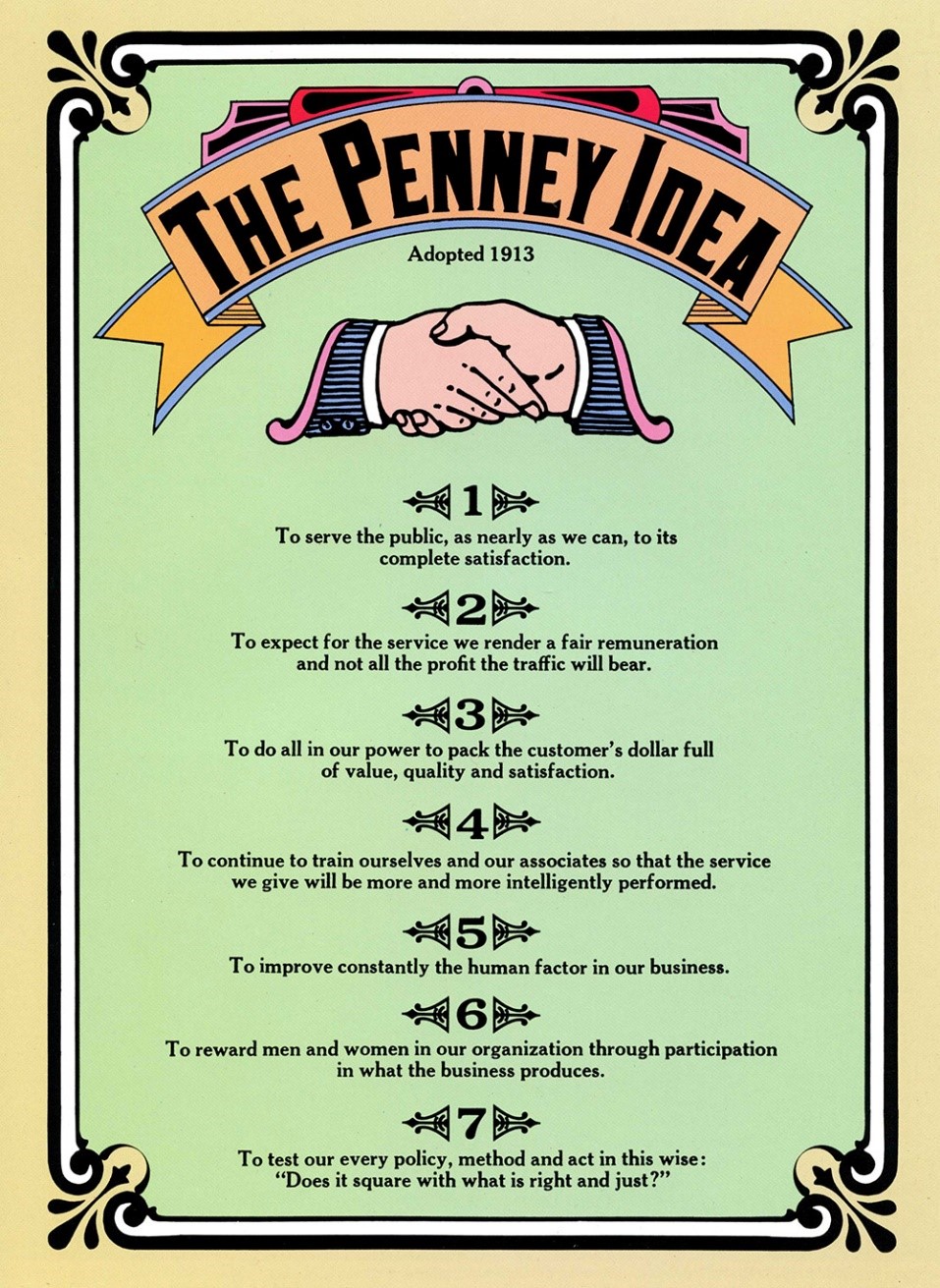
Penney was raised under a religious household, his father was a preacher. His father laid out for him a good moral foundation, something Penney took to heart. Penney lived by the Golden Rule and he built his empire with that rule at its core. The following rules were adopted in 1913 by J.C. Penney and his partners as a guide to business conduct.
Rule 1: To serve the public, as nearly as we can, to its complete satisfaction. Meaning Penney wanted his stores to provide the best service possible to his customers. He understood that a customer wasn’t just a one time buyer, but rather wanted to build a long-lasting relationship with everyone who came into the stores.
Rule 2: To expect for the service we render a remuneration and not all the profit the traffic will bear. Meaning to be expected to receive money fairly for the services provided to the customer.
Rule 3: To do all in our power to pack the customer’s dollar full of value, quality, and satisfaction. Meaning to provide the most value for every dollar spent in the store. Penney believed in giving more than receiving and wanted the customers to feel satisfied not cheated out of their hard-earned dollars.
Rule 4: To continue to train ourselves and our associates so that the service we give will be more and more intelligently performed. Penney believed in education, in mentorship, in growth, and tried his best to build an organization that created leaders.
Rule 5: To improve constantly the human factor in our business. Penney found that human relationships were as important as any product sold.
Rule 6: To reward men and women in our organization through participation in what the business produces. Penney believed in being fair and treating others with the utmost respect and integrity, this he believed to his core. Hence he rewarded all who worked to be their best.
Rule 7: To test our every policy, method and act in this wise, “Does it square with what is right and just?” Penney’s religious influence was apparent in how he approached the world. He believed ethics and morality were the foundation to thriving and being in god’s grace. It is my personal opinion that Penney discovered timeless principles through his faith and this is why he was so successful.
I want to point out that it takes courage, discipline, and will power to commit one’s self to live a righteous life, but the story of J.C. Penney tells us that long-lasting success can only be achieved by living in such a way. There are countless stories of people who have amassed success just to lose it. Now there may be many factors for that and I don’t want to generalize, but I do believe that living righteously creates confidence, hope, and faith. Integrity is key for anyone pursuing success and as the saying goes, this will take you places that character defects will not allow you to go. So I encourage myself and you to figure out where we fall short and do our best to improve because it pays dividends to develop the self-discipline and will to do what’s right and just for ourselves and for others.
Research & Additional Resources
J. C. Penney, the Man: A Life of Perpetual Sharing
 The Learn & Practice
Leave a comment